Documentation
Everything you need to install, activate, and get the most out of SSDSentinel on your Apple Silicon Mac.
Installation
SSDSentinel runs on any Apple Silicon Mac (M1 and later) running macOS Ventura 13.0 or newer. It is not compatible with Intel Macs.
SSDSentinel v2.8
Apple Silicon only · macOS Ventura 13.0 or later
Includes a free trial. A license key is required to unlock full access.
How to Install
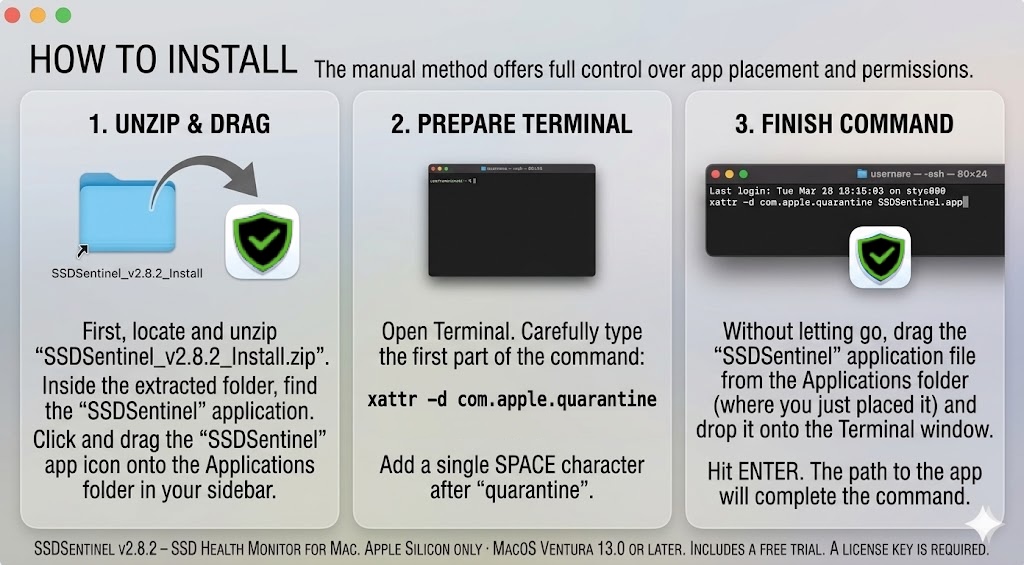
The manual method gives you full control over app placement and permissions. Since macOS blocks independent developers by default, follow these three simple steps to get running fast.
- Unzip & Drag: Unzip SSDSentinel_v2.8_Install.zip. Inside the folder, find SSDSentinel.app and drag it into your Applications folder.
- Prepare Terminal: Open Terminal and either copy paste or type the following command followed by a single SPACE after quarantine:
xattr -d com.apple.quarantine - Finish & Authenticate: Drag the SSDSentinel icon from your Applications folder directly into the Terminal window to complete the path. Hit Enter.
Why this method?
By using Terminal to clear the "quarantine" flag manually, you bypass the "System Settings dance" entirely. You won't need to hunt through Privacy & Security menus or click "Open Anyway"—the app will simply work as intended. The App is Not Damaged. Do Not Move it to the Trash. Just enter the xattr command above, and it will open normally ever after.
PRO TIP: When dragging the app into Terminal, make sure you leave that space after quarantine. Terminal will automatically fill in the long file path for you, so you don't have to type it out.
On first launch, after accepting the License Agreement, SSDSentinel will then appear as a shield icon in your menu bar. Running quietly in the background without cluttering your Dock.
Common Questions
Why use Terminal instead of a standard installer?
Using Terminal allows you to manually verify the app's placement and security status. By clearing the quarantine attribute yourself, you ensure a clean launch without macOS gatekeeper interference or unexpected background changes.
Is the Terminal command permanent?
Yes. Once you run sudo xattr -d com.apple.quarantine on the app, the "quarantine" flag is permanently removed. SSDSentinel will open normally on every subsequent launch without any security warnings or "damaged file" errors.
Does this clutter my system?
Not at all. There is no "System Settings dance" or hidden background installers. Once moved to Applications and authenticated, SSDSentinel runs entirely from its own bundle. On first launch, just read and accept the License Agreement; the app will then sit as a shield icon in your menu bar, keeping your Dock clean. — All functions can be accessed from there as it runs quietly in the background
Free Trial & Activation
SSDSentinel includes a full-featured 7-day free trial — no credit card required. Every feature is unlocked during the trial period. The remaining trial days are shown in the menu bar dropdown.
When you are ready to activate a purchased license:
1. Click the SSDSentinel shield icon in the menu bar.
2. Select Activate License… from the menu.
3. Enter your license key (format: SENT-XXXX-XXXX-XXXX-XXXX) and the email address you used at checkout.
4. Click Activate. SSDSentinel will verify your key with the license server and unlock immediately.
Your license is tied to your Mac's hardware UUID and validated securely on our server. A single license covers the number of Macs shown in your confirmation email..
If you activate while offline, SSDSentinel will accept your key and verify it automatically on your next internet-connected launch.
How Monitoring Works
SSDSentinel watches three key system log directories in real time:
/var/log — System-level daemon and kernel logs.
/Library/Logs — Application and framework logs.
/var/db/diagnostics — Apple's unified logging diagnostic snapshots.
Every 15 minutes the sentinel checks the total size of these directories and updates the menu bar shield icon accordingly:
Green shield — All clear. Log volume is within the normal baseline for Apple Silicon Macs.
Yellow shield — Warning. Log volume has exceeded 2 GB and is worth monitoring.
Red shield — Danger. Log volume has exceeded 5 GB. A log storm is likely in progress.
SSDSentinel also monitors your SSD's usage level alongside the log data so you always have a complete picture of drive capacity at a glance.
Click Refresh Stats Now in the menu at any time to trigger an immediate check without waiting for the next scheduled cycle.
Storm Control
When a log storm is detected, click ⚡ ENGAGE STORM CONTROL in the menu to open the Storm Control panel. This gives you a live dashboard showing:
— Real-time log write rate, SSD usage level, and storm severity cards that refresh every 10 seconds.
— A full hardware profile of your Mac including chip, CPU, GPU, RAM, serial number, macOS version, uptime, IP address, storage usage, and memory pressure.
— The Storm Response Toolkit — four pre-loaded Terminal commands that walk you through identifying and killing the runaway process causing the storm.
— The Mac Power Toolkit — an advanced library of over 40 categorised commands covering audio, display, network, performance, and system diagnostics.
— Platinum Log Reset — a one-click deep clean that erases all accumulated log files and resets your write baseline. Requires your admin password.
All Storm Control commands are loaded into Terminal for your review — you press Enter to execute. Nothing runs silently without your approval.
System Health Report
Select 💻 System Health Report… from the menu to open a detailed real-time report covering CPU, GPU, RAM, storage, battery health, uptime, network status, last Platinum Reset date, and more. The report refreshes live and can be exported or referenced during support conversations.
SSD Wear Level — What It Means & How to Use It
The SSD Wear Level can be found in the Storm Control Hardware Profile. It shows the true flash endurance consumed by your SSD, read directly from the drive's NVMe SMART controller — this is completely different from how full your disk is. A reading of 0% consumed means your drive's flash cells are essentially brand new regardless of how much data has passed through them. The metric also displays Available Spare, which is the percentage of reserve flash blocks your drive still has on hand to replace any worn cells.
To enable this feature, smartmontools must be installed — if you see Run in Terminal: brew install smartmontools in the WEAR row, simply open Terminal, paste: brew install smartmontools then press Enter, and relaunch Storm Engine. Once installed, Storm Engine will display your wear level, endurance remaining, and spare block availability, color coded green for healthy, yellow as a caution above 70% consumed, and red as a critical warning above 90% consumed. Most modern SSDs are rated for 100–600TB of writes before reaching end of life, so for the majority of users this number will stay green for the lifetime of their Mac.
FAQ
Does SSDSentinel work on Intel Macs?
No. SSDSentinel is compiled specifically for Apple Silicon (arm64) and requires an M1 or later Mac running macOS Ventura 13.0 or newer.
Does SSDSentinel run in the background?
Yes. SSDSentinel is a menu bar app — it runs quietly as a background agent (LSUIElement) and never appears in the Dock. It uses minimal CPU and checks logs every 15 minutes on a lightweight timer.
Why is my shield yellow or red after a macOS update?
macOS updates often generate large volumes of diagnostic logs during and after installation. This is normal. Use Platinum Log Reset in Storm Control to clear the post-update accumulation and restore your baseline.
What is a log storm?
A log storm happens when one or more processes write millions of log entries in a short window, filling your log directories far beyond their normal baseline. Common causes include crashed daemons restarting in a loop, buggy apps printing debug output continuously, or system services like logd or mds going haywire. Left unchecked, a log storm can write tens of gigabytes to your SSD in hours, accelerating wear.
Will Platinum Log Reset delete anything important?
Platinum Log Reset removes accumulated log files and diagnostic snapshots — it does not touch your personal files, documents, photos, or application data. Audit log files (audit*) are preserved. The reset is irreversible, so SSDSentinel asks for confirmation twice and requires your admin password before proceeding.
My trial shows the wrong number of days. What do I do?
Make sure SSDSentinel has network access so it can check in with the license server on launch. If you are running a firewall like LuLu, approve SSDSentinel's outbound connections when prompted. If the issue persists, contact support@ssdsentinel.com.
Can I use one license on multiple Macs?
License tiers vary by seat count — check your confirmation email for details. If you need additional seats, you can purchase them at ssdsentinel.com/pricing.
How do I completely uninstall SSDSentinel?
Quit SSDSentinel from the menu bar, then run the following commands in Terminal:
rm -rf /Applications/SSDSentinel.app

rm -rf ~/Library/Preferences/com.ssdsentinel.SSDSentinel.plist

rm -rf ~/Library/Containers/com.ssdsentinel.SSDSentinel

rm -rf ~/Library/Caches/SSDSentinel
Still need help?
Email us at support@ssdsentinel.com and we'll get back to you promptly.